Maths at Faldingworth School
Intent
Across the Fair Acre Federation, it is our intent to provide a high quality Mathematics education driven by the desire to enable all children to become confident and independent mathematicians.
The National Curriculum (2014) aims to ensure that all children:
- Become fluent in the fundamentals of Mathematics.
- Are able to reason mathematically.
- Can solve problems by applying their Mathematics
Our aim for all children is that they understand the importance of Maths in the wider world and how essential it is in everyday life: critical to science, technology and engineering; necessary for financial literacy and most forms of employment.
Implementation
Our children will be taught Mathematics in a way that ensures progression of the knowledge and skills set out in the National Curriculum (2014), and follows a sequence to build on previous learning. Through their lessons children will become fluent in the fundamentals of mathematics, including through varied and frequent practice with increasingly complex problems over time. They will develop conceptual understanding and the ability to recall and apply knowledge rapidly and accurately. Pupils will reason mathematically by following a line of enquiry, conjecturing relationships and generalisations, and developing an argument, justification or proof using mathematical language. Pupils will be able to solve problems by applying their mathematics to a variety of routine and non-routine problems with increasing sophistication, including breaking down problems into a series of simpler steps and persevering in seeking solutions. We aim to present maths as a challenging, exciting, creative and relevant subject.
We use White Rose Maths schemes of learning as our main resource for teaching and learning. The schemes are designed to give teachers sufficient time to explore and understand a concept in depth. Teachers can use the White Rose scheme flexibly with mixed age classes to ensure good coverage and progression. The schemes interleave prior content with new concepts. For example, when children look at measurement, it is suggested that they tackle lots of questions that practise the four operations and fractions. This practice and consolidation helps children grasp the links between topics and understand them more deeply.
We reinforce number fuency throughout the year, through mental or oral starters or in additional maths time during the day eg cold maths.
Our calculation policy gives clear steps through the development of skills involved in addition, subtraction, multiplication and division. It provides examples of how these can be taught in a clear progressive way taking pupils through the steps of concrete, pictorial and abstract representations. The use of the policy ensures a systematic approach to the teaching of mathematical skills across our federation.
We believe children will become mathematicians when the teaching, learning and sequencing of the curriculum includes the following:
- Memorable experiences which help knowledge, skills and vocabulary to ‘stick’
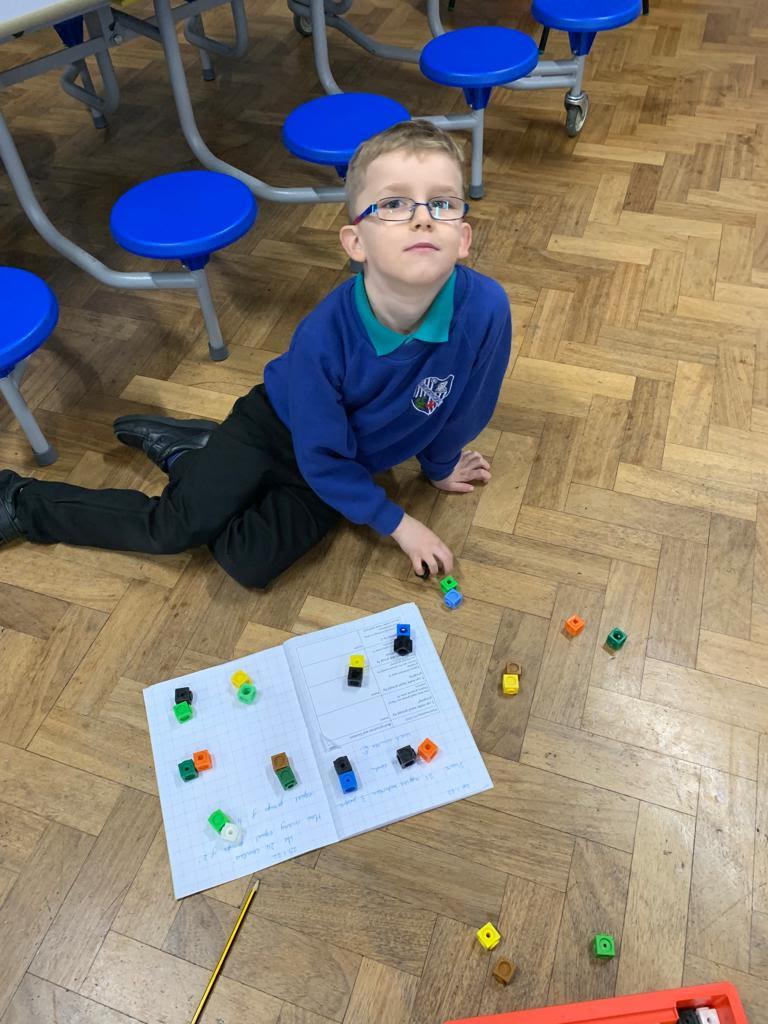
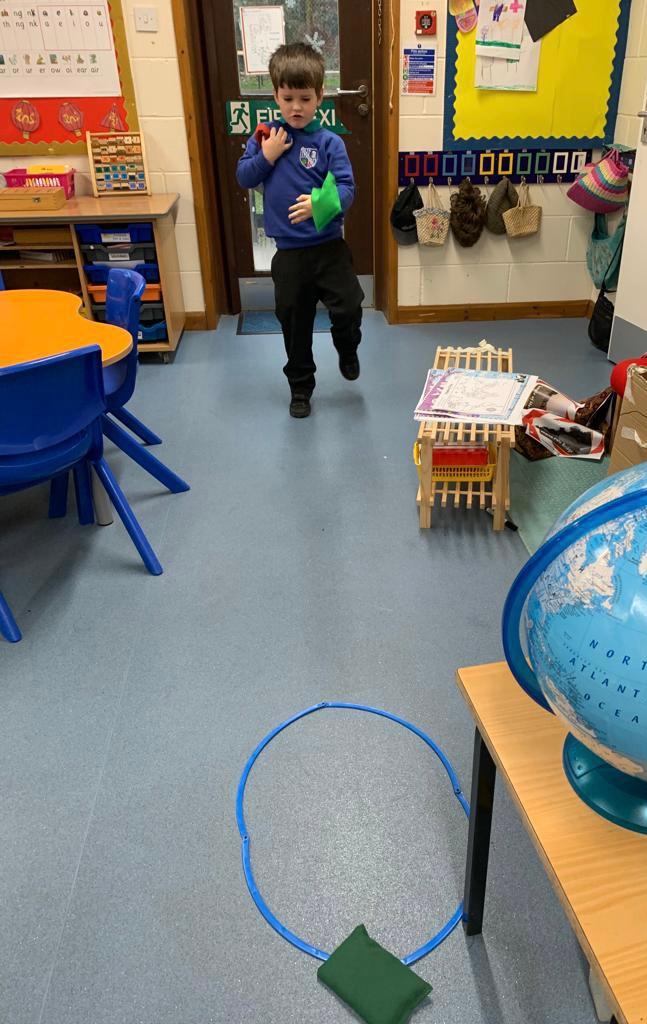
- Enhancing the learning through the environment –images, practical resources, vocabulary
- In addition to maths lessons, we spend extra time singing number songs, practising times tables and completing ‘cold maths’ tasks as appropriate for different ages
- Questioning is used to test conceptual understanding and procedural knowledge and assess the children throughout lessons
- ICT is used to enhance and enrich maths provision when possible eg Times table rock stars, NRICH resources, IXL, BBC Bitesize, Purple Mash
- Finding out what the children already know (eg KWL grid, cold maths) and knowledge organisers
- Number facts taught and revisited often through ‘mental starter’ type beginning to lessons and regular practise
- Regular homework which seeks to reinforce classroom learning
- Children have a record of learning in their exercise books and White Rose booklets
- Activities are scaffolded according to the needs of the children and so that every child experiences success in the subject. This can be through use of resources, images, pre-learning tasks and level of support given.
- Additional tasks can be differentiated to ensure that all children can access them and have an appropriate level of challenge
- Intervention sessions are planned through pupil progress meetings to help children to meet their learning targets
- In the moment marking helps teachers identify children who would benefit from extra support or challenge before the next lesson
- Children will take part in peer and self marking activities as appropriate
- We aim to provide a maths club for one term a year in school. ‘Magical Maths’ is an example of this.
- Cross curricular opportunities are considered as a means of enhancing children’s learning
- In Early Years there are continuous provision opportunities to develop mathematical skills and knowledge as well as daily maths sessions
Impact
Our mathematics curriculum is high quality, well thought out and is planned to demonstrate progression. We focus on progression of knowledge, skills and vocabulary in each unit of work. Assessment is an integral part of the teaching and learning process. Teachers monitor progress in a formative way and adjust their teaching accordingly. The assessment of children’s work is on-going to ensure that understanding is being achieved and that progress is being made. Feedback is given to the children as soon as possible, and marking work will follow the school’s marking policy.
We measure the impact of our curriculum through the following methods:
- Daily assessment for learning (AfL), verbal feedback and written marking
- Images of the children’s practical learning/learning walks and observations.
- ‘Cold Maths’ and ‘Big Solve’ give opportunities for the children to independently apply their knowledge and skills
- Summative assessments including end of unit assessments and Progress in Understanding Mathematics Assessment tests each term (PUMA)
- End of EYFS assessment of the Early Learning Goals
- SATs are taken at the end of KS1 and KS2 and data is used to inform next steps
- Data is regularly scrutinised in pupil progress meetings and teachers plan for all children to make good or better progress.
- A proportion of children will demonstrate learning with greater depth at the end of each key stage
- Interviewing the pupils about their learning (pupil voice).
- Moderation staff meetings where pupil’s work is scrutinised and there is the opportunity for a dialogue between teachers to understand their class’s work.
- Annual reporting of standards across the curriculum.
- Action planning for further development

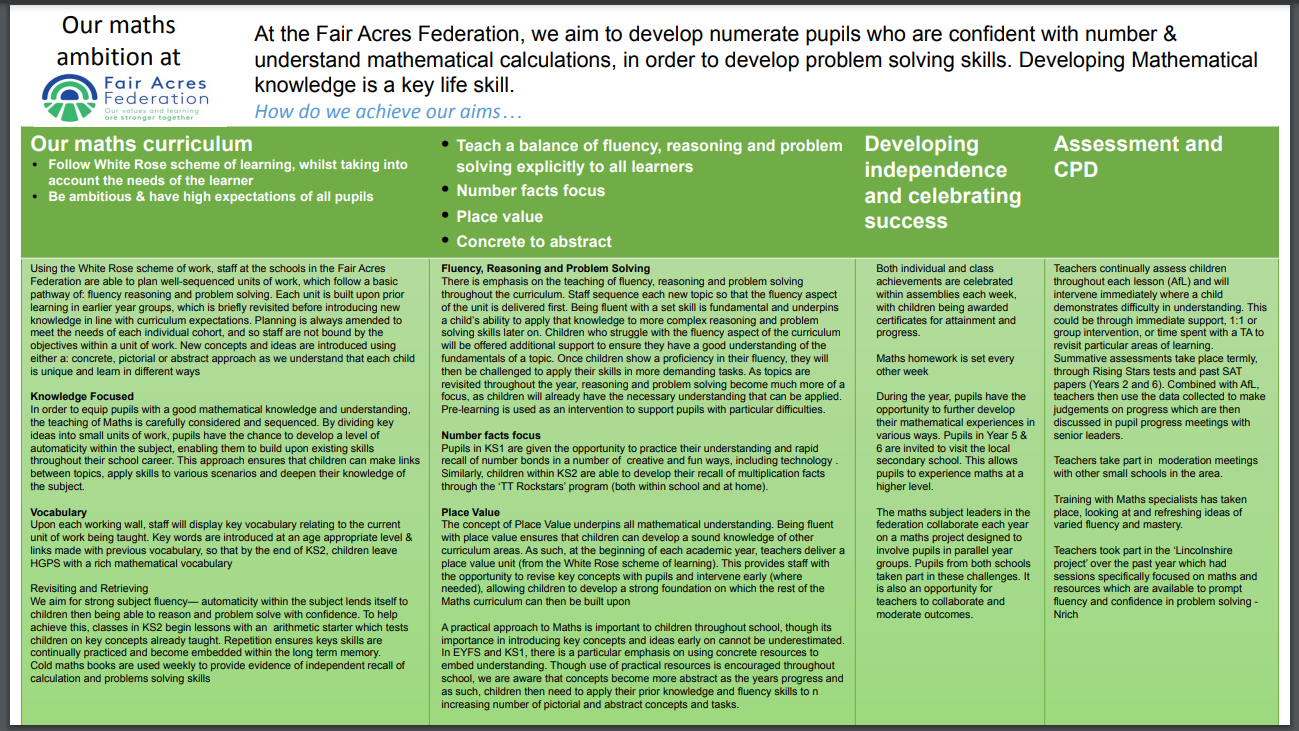
Click on the image to find out more about how we achieve our aims

|
Maths Intent Imp and Impact plus policy (1) | [docx 79KB] |

|